
Advancing drug discovery for renal fibrosis
Renal fibrosis, or kidney scarring, is a final common pathway of all chronic kidney diseases (CKD), ultimately leading to end-stage renal disease (ESRD). As a leading cause of morbidity and mortality worldwide, CKD presents a significant challenge to global health. The development of new and effective treatments to halt or reverse renal fibrosis is a key focus of preclinical drug development. A specialized nephrology CRO, like Gubra, provides comprehensive preclinical research services and clinically translatable models to help advance these critical drug discovery efforts. By leveraging our deep expertise and a robust portfolio of in vivo models, we help pharmaceuticals, and biotech partners accelerate their path towards new therapies.
The pathology of kidney fibrosis
To understand how to combat renal fibrosis, it is crucial to first understand its pathophysiology. At its core, renal fibrosis is the result of a persistent wound-healing response within the kidney. Damage to kidney cells, often caused by chronic conditions like hypertension or diabetes triggering an inflammatory response. This inflammation leads to the activation of fibroblasts, which are responsible for producing and depositing excessive extracellular matrix (ECM) proteins. This overproduction of ECM results in the formation of fibrosis that can occur both as glomerulosclerosis (scarring of the glomeruli) and tubulo-interstitial fibrosis.
The accumulation of scar tissue disrupts the normal kidney architecture, impairing its ability to filter blood and regulate body fluids. Over time, this leads to progressive loss of kidney function, including glomerulosclerosis and renal interstitial fibrosis. Understanding these aspects of chronic kidney disease pathophysiology is essential for developing targeted therapies that can slow or stop the progression of what causes scar tissue on kidney. At Gubra renal fibrosis histology examination is a key endpoint and highly standardized to characterize disease state.
Renal preclinical models: the key to unlocking new therapies
Preclinical research is the cornerstone of drug discovery, and selecting the right in vivo models is a critical step in this process. Gubra offers a broad portfolio of robust and translational renal fibrosis models that are essential for evaluating the efficacy of new drug candidates. Our extensive experience with these kidney models allows us to provide a high level of certainty in the data and a clear path forward for drug development.
Our services include a variety of well-established rodent models that recapitulate key features of human kidney disease. These include:
- Unilateral ureteral obstruction (UUO): A surgically induced mouse model of kidney known for its robust and rapid induction of tubulointerstitial fibrosis and inflammation. It is ideal for the fast screening of drug efficacy.
- Adenine diet-induced (ADI) CKD mouse model: This dietary model induces rapid onset and progression of CKD, characterized by impaired kidney function and robust renal fibrosis, making it suitable for profiling drug effects on GFR and I a kidney fibrosis mouse model.
- 5/6 nephrectomy rat model: A classic surgical model that induces progressive kidney failure, including glomerulosclerosis and tubulointerstitial fibrosis, and is ideal for profiling drug effects on GFR and renal fibrosis.
- ReninAAV UNx db/db mouse model: This advanced model of hypertensive diabetic kidney disease (DKD) is designed to closely mimic human disease by combining obesity, hyperglycemia, and hypertension. It is a flagship kidney fibrosis model for testing effects on albuminuria and glomerulosclerosis.
By using these specialized models, researchers can gain valuable insights into the mechanisms of action of their compounds and generate the data needed to advance to clinical trials.
Do you want to learn more about the specific features of our models? You can find detailed descriptions and applications for each of our models in our latest article here: Best preclinical kidney disease models for CKD, DKD, and Renal Fibrosis.
Partnering for success in preclinical drug development
Gubra is committed to advancing preclinical drug development for renal fibrosis. Our deep scientific expertise, combined with our portfolio of clinically relevant fibrosis models and state-of-the-art technologies, positions us as a trusted nephrology CRO partner. From study design to data analysis, we provide full-service solutions to help you unlock new insights into kidney health. We offer clear, conclusive data with precise presentation, ensuring you have the information you need to make informed decisions for your preclinical research. To learn more, contact our experts and explore our posters below:
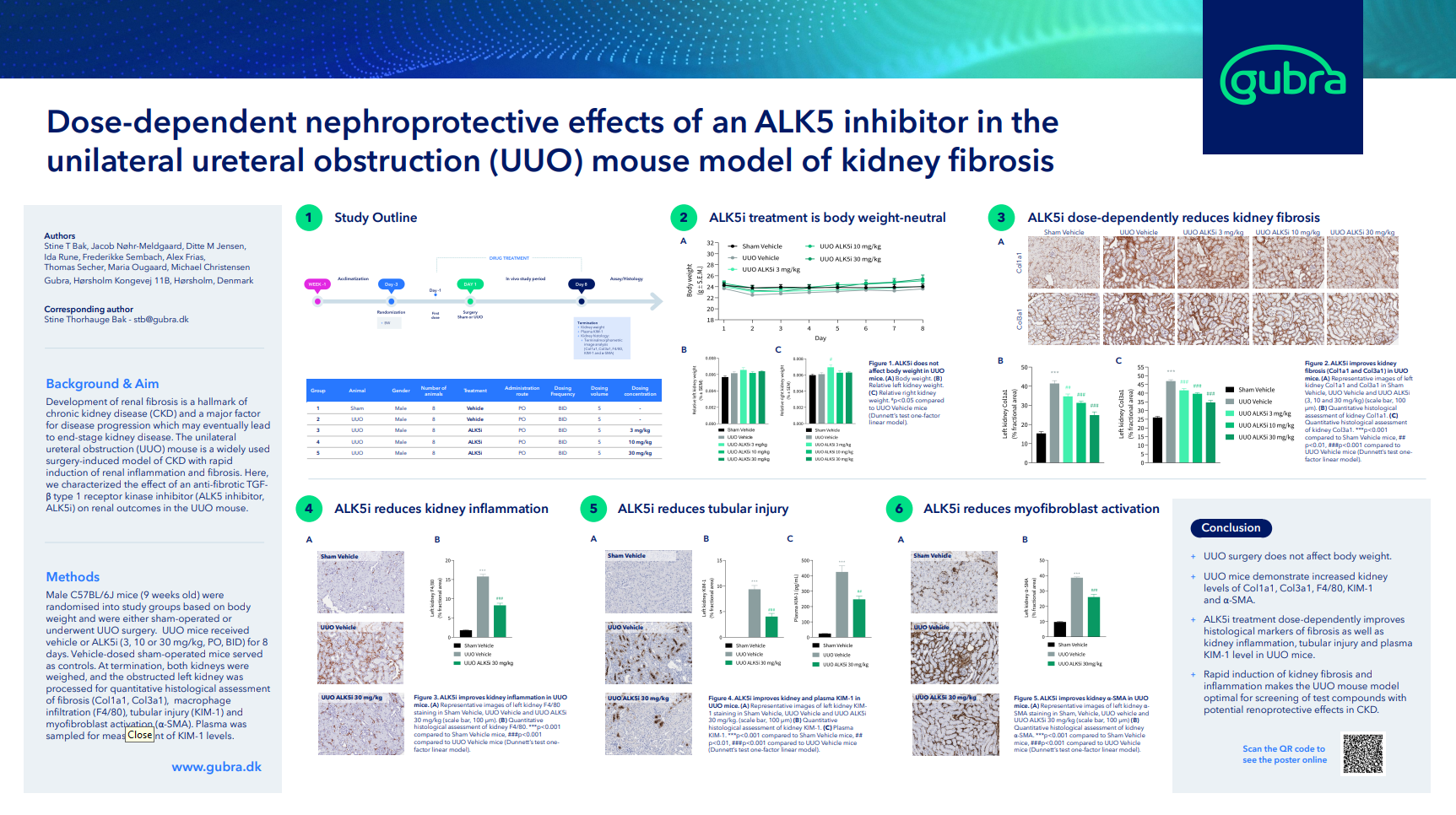
1. Dose-dependent nephroprotective effects of an ALK5 inhibitor in the unilateral ureteral obstruction (UUO) mouse model of kidney fibrosis
Conclusions:
- UUO surgery does not affect body weight
- UUO mice demonstrate increased kidney levels of Col1a1, Col3a1, F4/80, KIM-1 and α-SMA
- ALK5i treatment dose-dependently improves histological markers of fibrosis as well as kidney inflammation, tubular injury and plasma KIM-1 level in UUO mice
- Rapid induction of kidney fibrosis and inflammation makes the UUO mouse model optimal for screening of test compounds with potential renoprotective effects in CKD
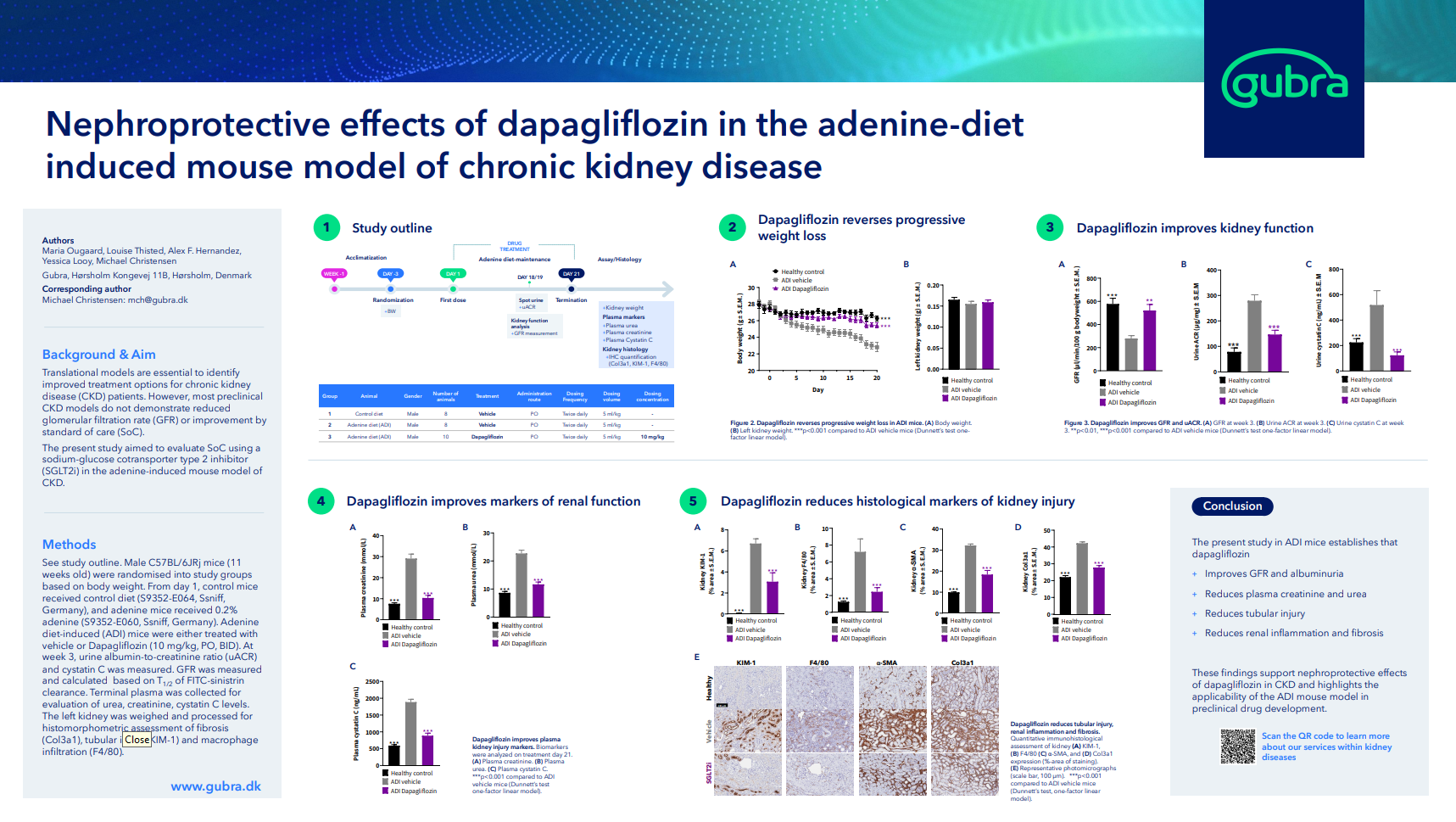
2. Nephroprotective effects of dapagliflozin in the adenine-diet induced mouse model of chronic kidney disease
Conclusions:
The present study in ADI mice establishes that dapagliflozin:
- Improves GFR and albuminuria
- Reduces plasma creatinine and urea
- Reduces tubular injury
- Reduces renal inflammation and fibrosis
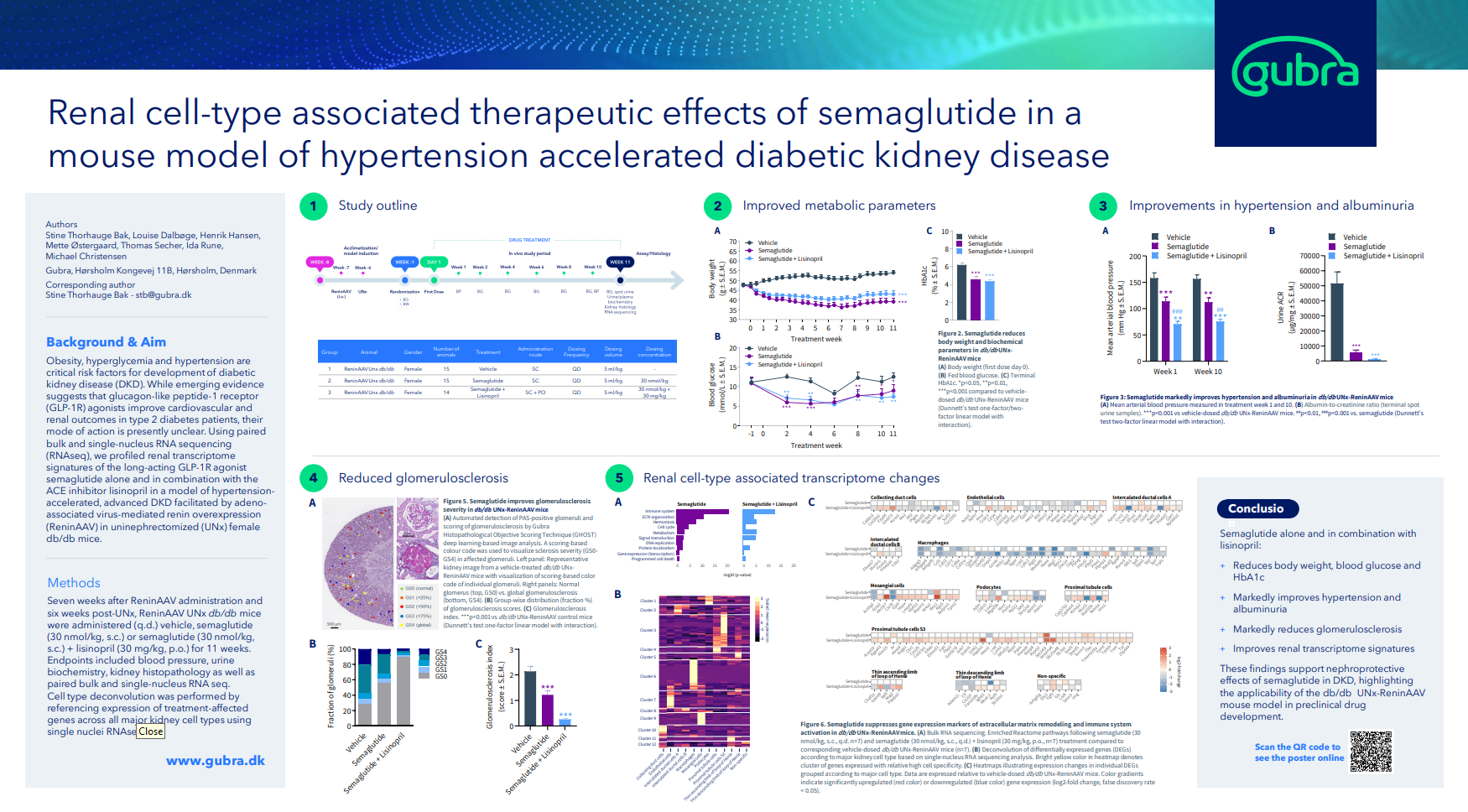
3. Renal cell-type associated therapeutic effects of semaglutide in a mouse model of hypertension accelerated diabetic kidney disease
Conclusions:
Semaglutide alone and in combination with lisinopril:
- Reduces body weight, blood glucose and HbA1c
- Markedly improves hypertension and albuminuria
- Markedly reduces glomerulosclerosis
- Improves renal transcriptome signatures