
PEPTIDE THERAPY
The streaMLine™ Platform
streaMLine™ is a machine learning-based peptide drug discovery platform developed at Gubra to streamline the design, synthesis, screening, and optimization of therapeutic peptides. It enables machine learning–assisted analysis of thousands of peptides, supporting a workflow across three stages, all typically achievable within 12-15 months.
What are the three stages of streaMLine™?
- In silico hit generation
- In vitro multi-parameter optimization of any peptide backbone
- In vivo validation of frontrunners


Consult with Niels Vrang
Co-founder & Scientific Advisor
Choose the right, trustworthy discovery partner.
Unlock Data-Driven Insights and Fast-Track Candidate Selection with streaMLine™
streaMLine™ accelerates peptide drug discovery by uniting computational and experimental workflows into a single, integrated platform. It supports both de novo peptide design and existing scaffolds, including noncanonical amino acids and macrocycles. By optimizing pharmacological and physicochemical properties in parallel, streaMLine™ enables faster transitions from hit to early in vivo studies. AI and high-throughput screening drive data-guided, explainable decisions—advancing only the most promising candidates.
Key Benefits of streaMLine™

From First Hit to Early In Vivo – Faster

Optimise Multiple Properties Simultaneously

Built-in Support for ncAAs

Data‑Driven, Explainable Decisions

Early In Vivo Confidence
Wet lab exploration powered by explainable AI
Accelerated Peptide Discovery Through High-Throughput Screening and AI Drug Discovery
Our platform supports both de novo binder generation and systematic optimization of known peptides. Entry into the drug discovery pipeline can begin from a target structure, an endogenous ligand, or any known binder.
Hover over the model to view details.
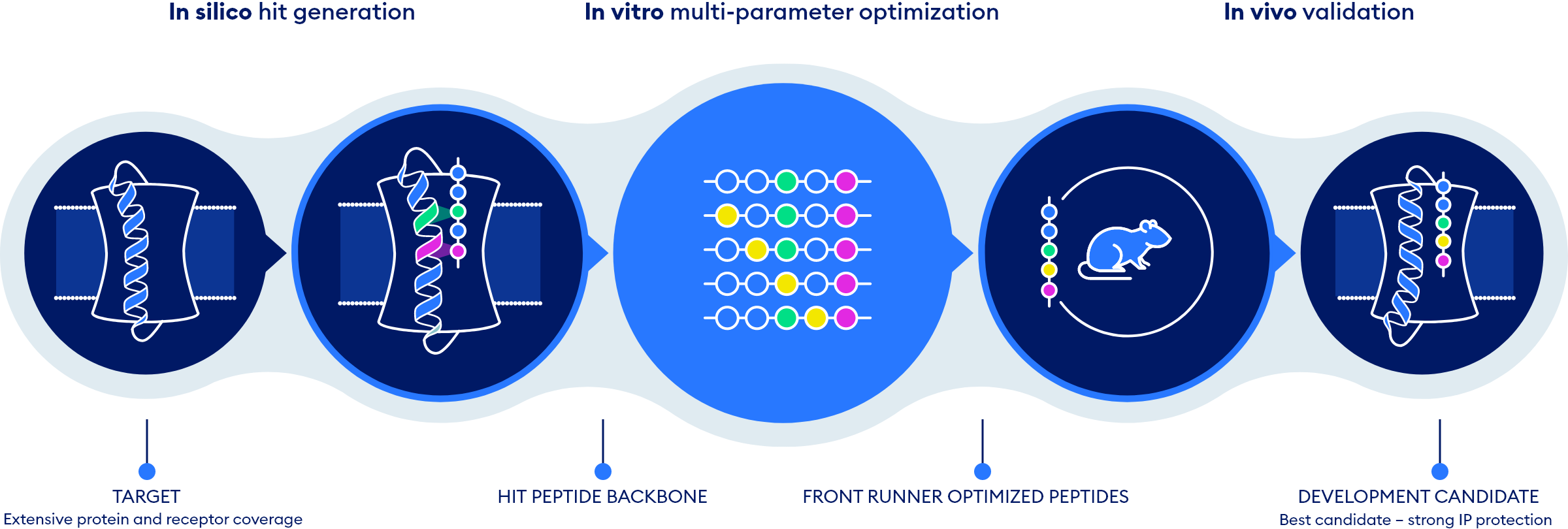

In Silico hit generation
AI‑driven drug discovery converts target structures into thousands of ranked peptide designs, condensed into a structurally diverse short‑list for experimental evaluation.
- Structure‑Driven Peptide Ideation Relaxed Sequence Optimization (RSO) explores ~5–10 k candidate peptides per target—spanning both linear and cyclic backbones —around the receptor’s 3‑D structure.
- Multi‑Objective Consensus Scoring A suite of orthogonal deep‑learning predictors—covering structure fidelity, interface energetics, and sequence plausibility—produces a consensus score that ranks the most promising binders.
- Contact‑Space Clustering Alignment‑independent clustering based on target‑contact fingerprints selects a structurally diverse subset that captures distinct interaction modes for downstream testing.
- High‑Throughput In‑Vitro Validation & Rapid Mutagenesis Probing Hundreds of clustered designs are batch‑synthesised and screened; the best hits then undergo quick, systematic pooled variant scanning to gauge their potential for further hit‑to‑lead optimisation in large systematic peptide-design libraries.
Frank C. et al. “Scalable protein design using optimization in a relaxed sequence space,” Science 386, 439‑445 (2024).

In vitro multi-parameter optimization
Comprehensive screening, paired with explainable AI, tracks how sequence changes impact key pharmacological and physicochemical traits—guiding iterative trade‑off decisions.
- Systematic Peptide Library Design Peptides are synthesized in large, systematic libraries (typically thousands) using solid-phase peptide synthesis. All libraries are designed so that each amino acid substitution appears in multiple contexts, increasing statistical robustness for model training.
- High-Throughput Screening Peptides are simultaneously screened in high-throughput assays for receptor potency, physicochemical properties (solubility/turbidity, fibrillation tendency), and chemical & plasma stability.
- Machine Learning-Guided Optimization For each screening endpoint, random-forest models are trained to relate peptide sequence to functional outcomes. Explainable AI highlights the amino-acid substitutions that boost activity or improve developability, while batch effects are modelled to improve prediction accuracy.
- Iterative and Parallelized Workflows The platform enables multi-parameter optimization, allowing parallel exploration of:
- Receptor potency & selectivity
- Solubility & aggregation behavior
- Chemical & plasma stability
- Half-life extension via lipidation/protraction

In vivo validation
Early, focused in vivo studies in mouse, rat, or minipig generate PK and PD data that either nominate candidates for preclinical drug development or feed directly back into design.
- Early, Informed Entry into In Vivo Studies When supported by multi-parameter in vitro performance, selected peptides are advanced early to in vivo testing—ensuring translational relevance while upholding animal welfare through data-guided selection.
- Pharmacokinetics and Pharmacodynamics Across Species In vivo validation includes PK and PD studies in mouse, rat, and minipig, aligned with the target’s mechanism and therapeutic context.
- Translational Confidence and Design Feedback In vivo results either support preclinical candidate nomination or guide further design iterations—closing the loop between computational design, wet-lab optimisation, and physiological relevance.
Related pages





For further information
Contact us
Gubra
Hørsholm Kongevej 11B
2970 Hørsholm
Denmark
+45 3152 2650