


Quantitative 3D high-resolution imaging of skeletal muscle morphology in aged lean and diet-induced obese mice
Background & aim: Effective treatment of muscle diseases requires comprehensive, multidimensional assessment of muscle structure, mass, and function. This need is particularly evident in sarcopenia, where age-related loss of muscle mass and quality drives functional decline, increased morbidity, and frailty…
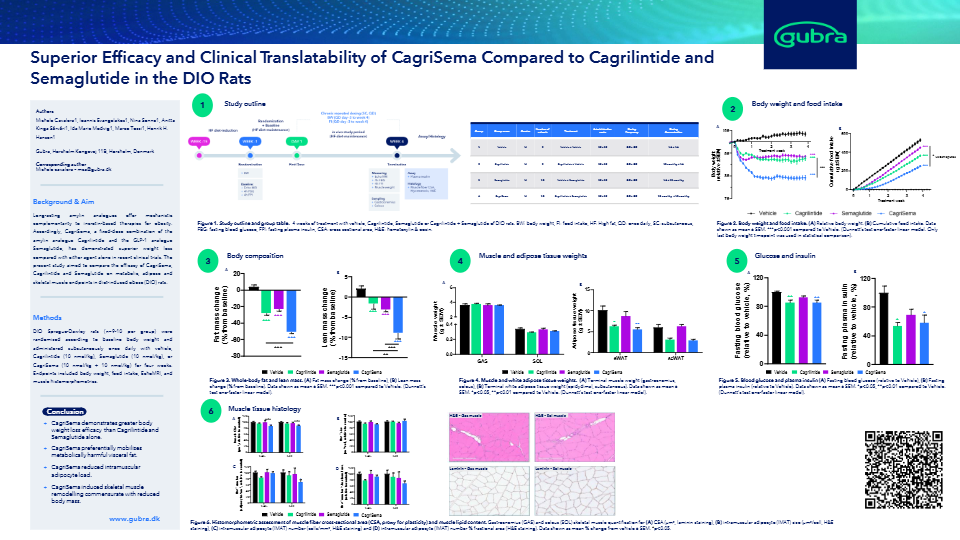
Superior Efficacy and Clinical Translatability of CagriSema Compared to Cagrilintide and Semaglutide in the DIO rats
Background & aim: Long-acting amylin analogues offer mechanistic complementarity to incretin-based therapies for obesity. Accordingly, CagriSema, a fixed-dose combination of the amylin analogue Cagrilintide and the GLP-1 analogue Semaglutide, has demonstrated superior weight loss compared with either agent alone in recent clinical trials…

Differential effects of semaglutide, tirzepatide, and survodutide on energy expenditure in obese mice under thermoneutrality
Background & aim: Obesity pharmacotherapy has significantly improved weight management, with semaglutide (GLP-1 receptor agonist), tirzepatide (dual GLP-1 and GIP receptor agonist) and survodutide (dual glucagon/GLP-1 receptor agonist) demonstrating substantial efficacy in reducing body weight. These drugs primarily act by…


Survodutide acts through circumventricular organs in the brain and activates neuronal regions associated with appetite regulation
Abstract: Survodutide is a novel GCG/GLP-1 receptor (GCGR/GLP-1R) dual agonist in clinical development for people with obesity and people with metabolic dysfunction-associated steatohepatitis (MASH). Preclinically, survodutide demonstrated body weight lowering efficacy through decreased energy intake and increased energy expenditure. Here,…

Generation and characterisation of a humanised GLP-1 receptor mouse model for translational drug development
Background: Injectable peptide-based glucagon-like peptide-1 receptor (GLP1R) agonists (GLP1RAs) are effective treatments for obesity and diabetes but are limited by patient compliance and scalability challenges. In contrast, non-peptide small-molecule GLP1RAs offer the advantage of oral delivery but are relatively inactive…